


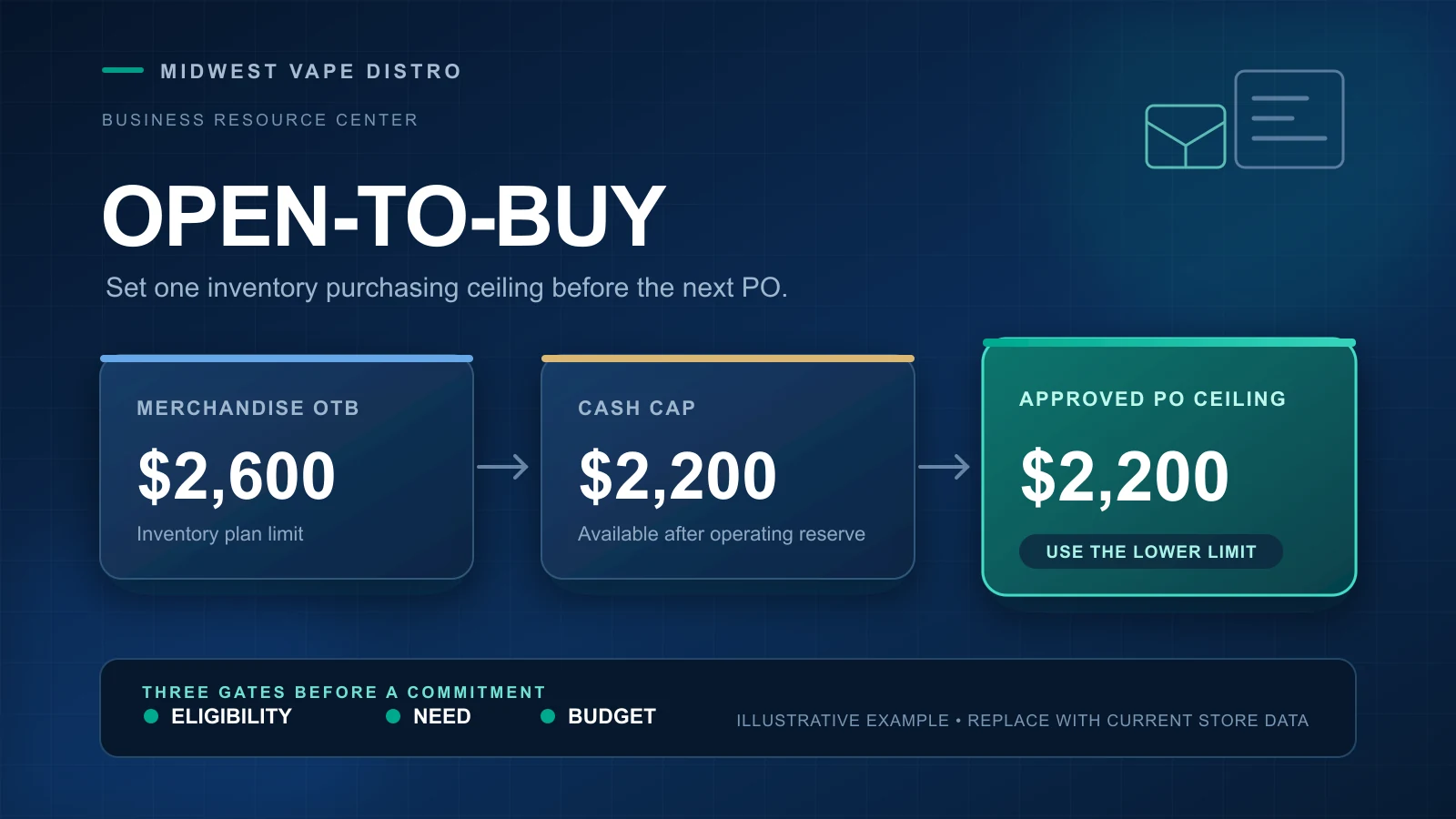
A vape shop’s open-to-buy (OTB) is the additional inventory value it can still commit for a defined receipt period after planned demand, target ending stock, current inventory and open purchase orders are reconciled. It is a buying ceiling. It is not a sales forecast, a reorder alert or the balance in the bank account.
Several SKUs can need replenishment while a launch and a case discount compete for cash. Without a category ceiling, sensible individual decisions can create an oversized combined purchase plan.
This guide builds a monthly inventory budget and OTB plan at cost, using the merchandise-cost amounts carried in supplier and inventory records. For this method, the receipt period is one calendar month in the store’s operating time zone, from its first day through its last. The downloadable workbook keeps the inputs, open commitments and approval decision in one place.
Download the vape shop open-to-buy planner
OTB, reorder points and deal math answer different questions
| Decision tool | Question | Level |
|---|---|---|
| Open-to-buy | How much additional inventory value can we commit this period? | Store or category |
| Reorder point | When should replenishment begin for this SKU? | SKU or variation |
| Bulk-discount test | Does the extra quantity earn enough benefit for the added cash and stock exposure? | One quote or price tier |
A SKU can reach its reorder point when its category has no budget left; positive OTB can also coexist with a poor case deal. Use the SKU-level reorder point worksheet for timing, the 30-day bulk-discount cash test for order tiers, and OTB for room in the total plan.
Define every input on one valuation basis
Open-to-buy can be planned at retail value, at cost or in units. Each is valid when every input uses the same basis. The common error is to subtract inventory recorded at cost from forecast sales recorded at retail. The result has no usable financial meaning.
A cost plan aligns on-hand stock, invoices and commitments on merchandise cost. Set one scope: a store and category, or a defined group. A transferred unit or cross-listed SKU must appear in only one inventory pool at a time.
- Beginning usable inventory at cost: the recorded merchandise cost of sellable stock physically available at the start of the period. Exclude stock already written off, returned, quarantined or assigned to another inventory pool.
- Planned COGS: the cost assigned to the units expected to sell during the period. If it is estimated from sales, use the category’s expected cost complement, not a universal store margin. Gross margin is net sales minus COGS, divided by net sales; a 40% gross margin therefore implies COGS equal to 60% of net sales.
- Target ending inventory at cost: the stock value the category should carry into the next period, based on its role, demand, lead time and shelf capacity.
- Planned inventory reductions at cost: inventory cost expected to leave during the period without a sale through documented shrink, damage, write-off or an approved return to vendor. Include only stock still counted in beginning usable inventory, so the same damaged or quarantined units are not deducted twice. Keep any related vendor credit visible in the cash plan rather than treating it as an automatic reduction in a new PO.
- Open POs at cost: merchandise already ordered and expected to be received during the defined calendar month. Count each PO line once, based on its current expected receipt date. Stock received before the period belongs in beginning usable inventory; a PO due after the period belongs in a future plan. When a delivery date moves, move the commitment rather than leaving it in two months.
A price markdown reduces stock value in a retail-value OTB. In a cost plan, a shelf-price change alone does not remove recorded merchandise cost, so do not enter it again as an inventory reduction. Treatment can differ under the retail inventory method, an impairment or another accounting policy; have the bookkeeper or accountant map those entries. The Retail Owners Institute’s OTB overview explains how planned sales and ending stock determine required receipts after beginning inventory.
Calculate the merchandise ceiling, then apply the cash ceiling
Start with the inventory balance for the same pool and receipt period:
Ending inventory = beginning usable inventory + receipts − COGS − planned inventory reductions
Rearrange it to find the receipts the merchandise plan requires, then subtract receipts already committed on open POs:
Available OTB at cost = planned COGS + target ending inventory at cost + planned inventory reductions at cost − beginning usable inventory at cost − open POs at cost
This is the merchandise ceiling. It shows what the stock plan can still absorb. It does not prove that the business can pay for that amount on the required dates.
Set a separate merchandise cash cap: money available for the merchandise cost of new POs after reserving existing PO payments, payroll, rent, tax, freight, other obligations and the chosen reserve. Compare merchandise cost with merchandise cost. Keep freight, duties, fees or tax in the cash schedule unless they are included consistently in every inventory input.
The receipt plan does not show invoice timing. Keep a separate schedule for actual deposit, balance, freight and tax due dates, including POs arriving in another period. This limitation lets positive OTB coexist with a failed cash test. Use the lower comparable merchandise amount:
Approved PO ceiling = the lower of merchandise OTB and the merchandise cash cap
If merchandise OTB is $6,000 and the cash cap is $4,000, the approval ceiling is $4,000. If cash available is $10,000 but OTB is $2,500, the ceiling is $2,500. Cash on hand cannot erase excess inventory, and a clean inventory plan cannot pay an invoice.
Worked example: a monthly category plan
A hypothetical category starts the month with $12,800 of usable inventory at cost. Planned net sales are $12,000 at a 40% gross margin, making COGS 60% of sales, or $7,200. The target ending inventory is $11,000, planned reductions are $200, and scheduled PO receipts are $3,000.
| Input or result | Illustrative amount |
|---|---|
| Beginning usable inventory at cost | $12,800 |
| Planned net sales | $12,000 |
| Planned COGS | $7,200 |
| Target ending inventory at cost | $11,000 |
| Planned inventory reductions at cost | $200 |
| Open POs at cost | $3,000 |
| Merchandise OTB | $2,600 |
| Merchandise cash cap | $2,200 |
| Approved PO ceiling | $2,200 |
The merchandise calculation is $7,200 + $11,000 + $200 − $12,800 − $3,000 = $2,600. Because the cash cap is lower, no more than $2,200 should be approved under these assumptions.
Now run a slower-sales case. If planned sales fall 15% to $10,200 while the 40% gross-margin assumption remains unchanged, planned COGS becomes $6,120. Merchandise OTB falls to $1,520. The approved ceiling therefore falls to $1,520 even though the cash cap is still $2,200. This is why a live OTB plan must change when the sales plan changes.
These are examples, not recommended margins or spending. Use the retailer’s records and plan. The U.S. Census Bureau defines an inventories-to-sales ratio as end-of-month inventory divided by monthly sales. Unlike OTB, that descriptive ratio does not reconcile reductions and committed receipts or authorize a PO. A broad trade measure is context, not a store target.
Approve each PO through three gates and two ceilings
- Eligibility gate: the exact item, variation, documentation and destination requirements have been checked against current authoritative information.
- Need gate: sales, lead time, stock position, customer demand or a controlled test plan supports the proposed quantity.
- Budget gate: the order fits the approved PO ceiling and the category allocation chosen inside that ceiling.
The need gate should reflect the item’s job. Protect proven core replenishment before allocating money to experiments, and give every seasonal or test buy a quantity limit and review date. The core, seasonal and test assortment framework provides those roles. Do not copy a fixed percentage from another retailer; use your sales mix, lead times, margins and risk tolerance.
Supplier performance also affects the inputs. Repeated partial fills or uncertain arrival dates can distort both the stock plan and the apparent need for backup inventory. Track line-level fills, damage and timing with the vape distributor fill-rate and assortment evaluation guide.
What to do when OTB is negative
Negative OTB means that, under the stated assumptions, beginning usable inventory plus in-period open PO receipts exceeds planned COGS plus target ending inventory plus planned inventory reductions by the displayed amount. It can indicate excess commitment, an outdated sales plan, an incorrect count or a receipt in the wrong period. It is a review signal, not permission to force the result to zero with a higher forecast.
- Reconcile the physical count, sellable status and cost records.
- Confirm that each open PO appears once and in the correct expected-receipt period.
- Pause discretionary test and launch orders.
- Review whether an open order can be changed under its actual terms; do not assume cancellation rights.
- Identify aged or misplaced inventory that may be transferred, returned, marked down or exited under applicable rules and store policy.
- Replace projections with actual sales and recalculate before approving another commitment.
Keep product condition and identity visible during any recovery decision. The receiving inspection SOP shows how to document shortages, damage and mismatches before they become hidden inventory adjustments.
Use a short weekly review with named owners
| Role | Weekly responsibility |
|---|---|
| Buyer or category owner | Update planned sales, category role, target ending stock and proposed POs. |
| Store or receiving lead | Confirm sellable on-hand stock, inbound receipts, damage and unresolved discrepancies. |
| Owner or finance lead | Set the merchandise cash cap from current obligations and payment timing. |
| Compliance owner | Record the product and destination checks used for the eligibility gate. |
| Final approver | Approve no more than the lower ceiling and record exceptions. |
One person may hold several roles; name each owner. Weekly, close actual sales and COGS, reconcile inventory, update open POs and arrival dates, refresh the cash cap and explain material variance. Plan stable categories monthly, but recheck current figures before approving a new commitment.
A new store can use conservative downside, base and upside cases, shallow tests and frequent revisions. The wholesale account readiness checklist assigns purchasing, billing and receiving responsibilities before a first order.
A distributor can use the same cost identity by category or customer group. Build demand from wholesale shipments, reorders, cancellations and concentration risk. Customer orders show distributor demand, not downstream consumer sell-through.
Open-to-buy planner FAQ
How often should a vape shop update OTB?
Build the plan before each month and refresh it weekly, or before any material PO, when sales, receipts, cancellations, reductions or cash availability change.
Should open purchase orders be included?
Yes. Include each PO line expected in the receipt period once. Do not also count a received line as beginning inventory or leave a delayed line in two periods.
Can OTB be positive when the shop cannot afford an order?
Yes. OTB measures merchandise capacity. The merchandise cash cap and cash-due schedule test whether the business can pay on the required dates.
Does negative OTB always mean the store is overstocked?
No. Reconcile counts, timing and assumptions first. A negative result can reflect excess commitments, slower planned demand, a duplicated PO or an incorrect period.
Can a new vape shop use OTB without sales history?
Yes. Start with conservative downside, base and upside cases, shallow test quantities and frequent updates as actual sales replace assumptions.
Download the open-to-buy workbook
The workbook separates inputs from formulas, calculates category OTB at cost, compares it with the cash cap, tests sales and margin scenarios, and applies the three gates to candidate POs. Replace the illustrative figures with current POS, inventory and purchase-order records.
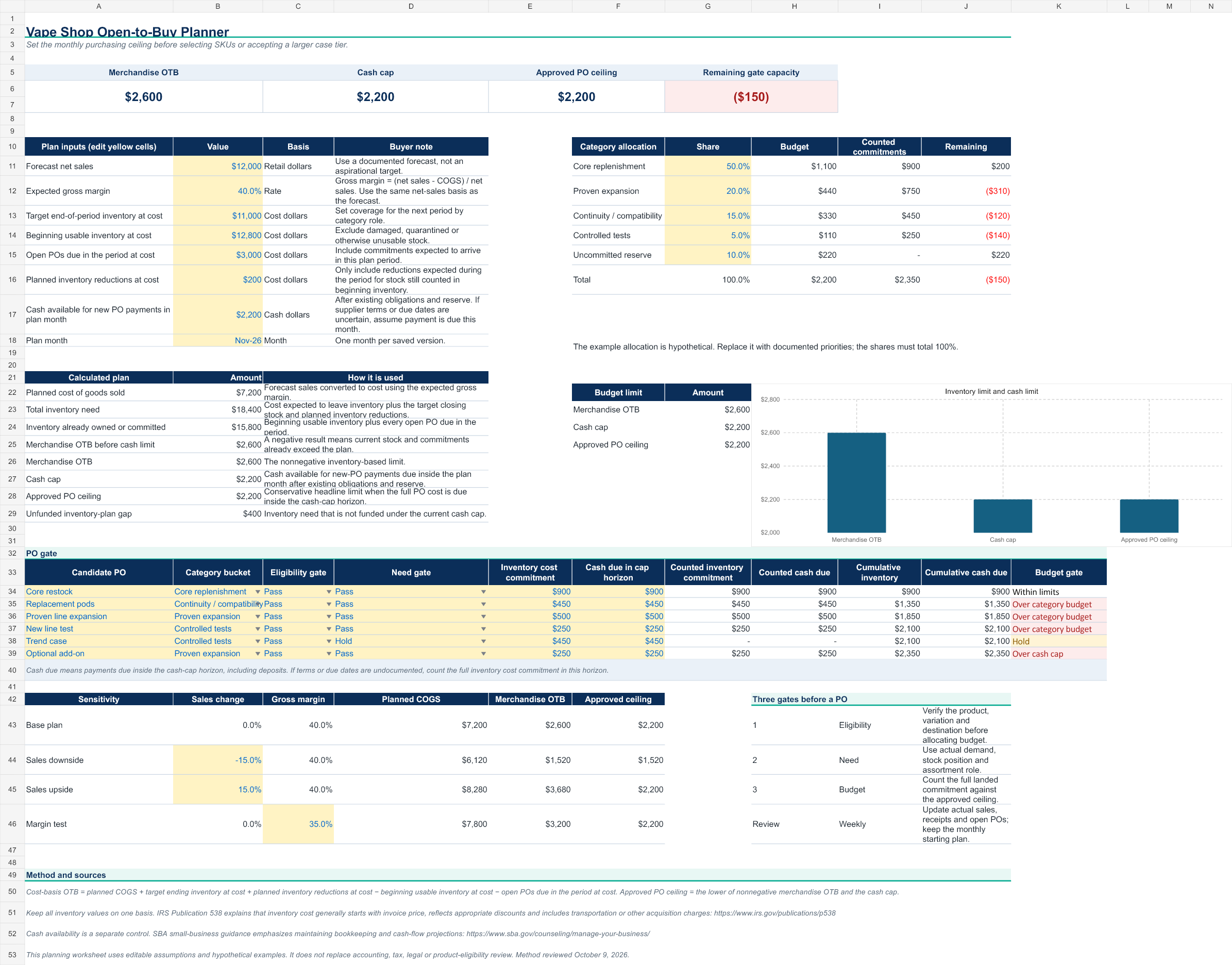
Download the vape shop open-to-buy planner
Use the ceiling with the next wholesale review
After the three gates pass, compare the approved amount with current account pricing, available variations and pack quantities in the wholesale catalog. Check current stock updates before treating an item as available. If the plan shows a documented assortment gap that is not listed, send the exact item, variation and expected quantity through Product Requests.
If open-to-buy turns negative, pause discretionary commitments and use the 30-day dead-stock review before setting the next purchasing ceiling.