



When a lower unit price requires a much larger case, count the discount only on units you expect to sell before your next buying review. Every extra unit left after that date is inventory still consuming cash.
The comparison is easy to miss when a quote puts unit cost first. A lower cost can improve the contribution from each unit sold, yet the larger opening payment can also delay a faster-moving reorder elsewhere. The useful question is not “Which tier has the best price?” It is “What does each tier do to cash, contribution and weeks of supply over the same period?”
The 30-day test below answers that question with a repeatable calculation for vape retailers and distributors. Use 30 days when it matches your buying cadence. If your business reviews orders every two weeks or every six weeks, use one normal review cycle instead.
Start with five inputs from the same SKU
Run the test at the variation level. A device family or product line can look healthy while one strength, flavor, color or pack configuration remains on the shelf. Use the exact selling unit in the quote and in the sales report.
- Proposed order quantity: the sellable units in each price tier, not only the number of cases.
- Landed unit cost: supplier price plus the inbound costs allocated to that unit. Keep rebates or credits separate until they are earned and documented.
- Expected demand during the review: a forecast based on the same SKU’s normal sales, adjusted for stockout days, promotions, returns and known account changes.
- Stock already available: sellable units on hand plus confirmed inbound units. Leaving these out makes both order choices look safer than they are.
- Order-to-shelf lead time: the time from an accepted order until the product is ready to sell, not the date a carrier label first appears.
Confirm the selling unit and case configuration before calculating. Current guidance on account pricing, minimum quantities, case packs and claims is available in the wholesale ordering FAQ.
Use formulas that keep cash and inventory separate
The test uses six calculations. Each one answers a different part of the buying decision:
- Available units = on-hand sellable units + confirmed inbound units + proposed order.
- Expected units sold = the lower of expected demand and available units.
- Ending inventory at cost = ending sellable units × landed unit cost.
- Contribution before overhead = expected units sold × (net selling price − landed unit cost − per-unit variable selling cost) − other order-level variable costs.
- Sell-through = expected units sold ÷ available units.
- Weeks of supply after the review = ending units ÷ expected weekly demand.
Contribution before overhead is not net profit. It does not include fixed occupancy, payroll, tax or financing costs unless a cost changes with the order and is entered in the model. Keeping that definition narrow makes comparisons consistent.
Worked example: 60 units or 120 units
Consider a hypothetical SKU with a net selling price of $14.99 and expected 30-day demand of 40 units. The smaller tier contains 60 units at a $7.50 landed cost. The larger tier contains 120 units at a $7.00 landed cost.
To isolate the quantity decision, the example starts with no sellable stock or confirmed inbound units. It assumes no stockout days, returns, markdowns, payment fees, claim losses, taxes, labor or financing costs. “Landed cost” includes supplier price and allocated inbound costs. A live review should add every variable cost that changes with the purchase or sale.
| 30-day measure | 60-unit tier | 120-unit tier | Larger-tier difference |
|---|---|---|---|
| Proposed order | 60 units | 120 units | +60 units |
| Landed unit cost | $7.50 | $7.00 | −$0.50 |
| Purchase cash | $450.00 | $840.00 | +$390.00 |
| Expected units sold | 40 | 40 | 0 |
| Contribution before overhead | $299.60 | $319.60 | +$20.00 |
| Ending units | 20 | 80 | +60 |
| Ending inventory at cost | $150.00 | $560.00 | +$410.00 |
| Sell-through | 66.7% | 33.3% | −33.4 points |
| Weeks of supply after review | 2.1 | 8.6 | +6.4 weeks |
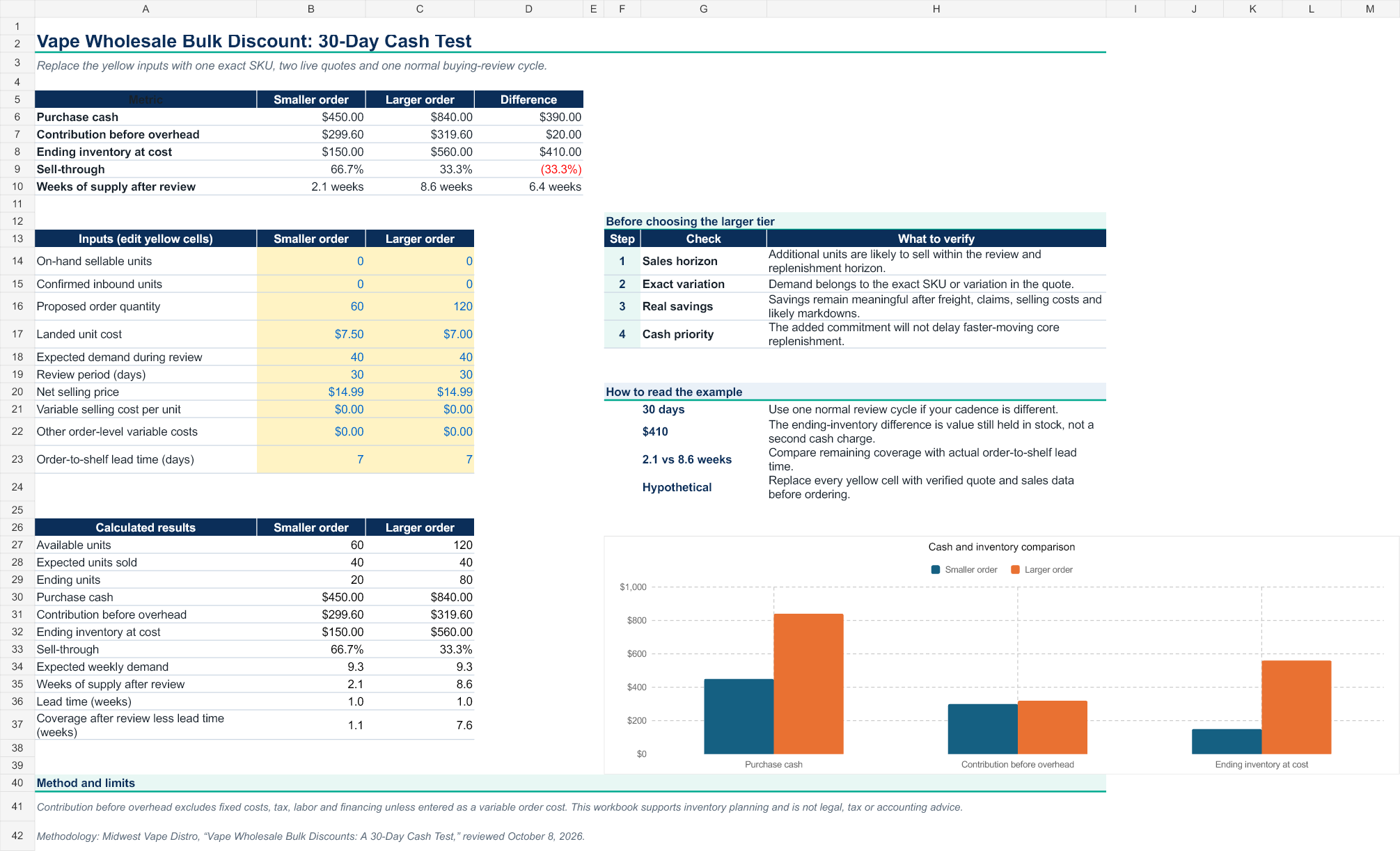
Both options sell the same 40 units during the month. The larger order adds only $20 of contribution from its lower unit cost. It requires $390 more cash at purchase and finishes with ending inventory at cost that is $410 higher.
The $410 difference is not a second cash charge and it is not a loss. Those units may produce future margin. They also remain exposed to slower demand, markdowns, damage, product changes and the cost of leaving another core SKU understocked. In the first review period, the buyer commits $390 more to gain $20 of additional contribution, or $19.50 of added purchase cash for each $1 of added 30-day contribution.
Lead time can reverse the answer
At a pace of 40 units in 30 days, the smaller order ends the review with about 2.1 weeks of supply. The larger order has about 8.6 weeks. If normal order-to-shelf lead time is one week and demand is stable, the smaller tier already carries more than a week of coverage after the review. The additional six-plus weeks in the larger tier may be unnecessary exposure.
If reliable replenishment takes eight weeks, the same numbers tell a different story. The smaller tier could create a stockout before the next shipment is ready. The reorder-point worksheet answers when replenishment should begin. This cash test answers how much to commit when a supplier offers different quantities or price tiers.
Set the category’s total monthly limit first with the vape shop open-to-buy planner, then apply this cash test to the exact quote and case tier.
Run at least one slower-demand case before accepting the larger tier. A 20% demand reduction changes expected 30-day sales from 40 units to 32. The larger order would then finish with 88 units, about 11.8 weeks of supply at the slower pace. That simple sensitivity often reveals more than the headline discount.
Retailers and distributors need different demand evidence
Retailers should forecast from point-of-sale units for the exact SKU. Adjust the history for days out of stock, temporary promotions, returns and known local changes. Customer requests can support a test order, but an unfulfilled request is weaker evidence than a completed repeat sale.
Distributors should also measure account concentration. One hundred units reordered by ten independent retail accounts provide a broader downstream demand signal than 100 units shipped once to one account. Retail-account reorders still do not prove consumer sell-through. When customers cannot share store-level sales, reduce the opening quantity and set the next review date before placing the order.
The product’s planned role matters as well. Core items can justify more depth when repeat demand and lead time support it. Seasonal and test items need a defined exit date. Use the core, seasonal and test assortment framework to assign that role before treating a price break as a reason to buy.
Choose the larger tier only when four conditions are true
- The additional units are likely to sell within the review and replenishment horizon.
- Demand belongs to the exact variation being ordered.
- The savings remain meaningful after freight, claims, variable selling costs and likely markdowns.
- The added cash commitment will not delay replenishment of faster-moving core SKUs.
If one condition is uncertain, use the smaller tier or ask whether another case configuration is available. After delivery, carry shortages, credits and substitutions into the actual landed cost. The receiving inspection SOP explains how to document those differences before inventory reaches the shelf.
Download the 30-day cash test worksheet
The workbook below includes the example, editable yellow inputs, formula-driven results, a cash-and-inventory chart and the four decision checks. Replace the sample values with the current quote and your own sales evidence.
Download the 30-day cash test worksheet
Run the live quote before the order
Sign in and check the live wholesale catalog for current account pricing, available options and pack quantities. Keep the quote, sales period, stock position and review date with the worksheet so the next buyer can understand the choice. If a documented assortment gap is not listed, send the exact model, variation and estimated quantity through Product Requests.